
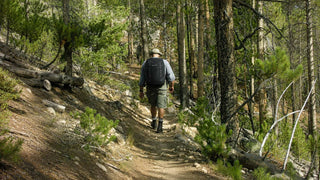
You've been walking regularly. Maybe you feel better for it, maybe your fitness has improved. But the scale isn't shifting the way you hoped.
That's not a discipline problem. Walking is genuinely good exercise. But it burns a relatively modest number of calories, around 200–280 an hour for most adults, and your body adapts to it quickly. After a few weeks, the same route takes less effort. The metabolic cost drops.
Load a backpack with 5–10 kg and the exercise changes. Your muscles work harder on every step, your heart rate climbs and your calorie burn goes up. Take that pack up some hills and it can roughly double.
That's rucking. And it's one of the more efficient tools available for weight loss that doesn't require a gym or a higher injury risk.
If you haven't come across rucking before, the What Is Rucking? guide covers the concept in full. This post focuses specifically on weight loss.
Key Takeaways
- On flat ground, a 10 kg pack adds roughly 10–20% to a walk's calorie burn. Take it up hills and you're near double: climbing hills with a 10–18 kg load rates 7.5 METs against 3.8 for a moderate flat walk (2024 Adult Compendium of Physical Activities).
- Rucking naturally sits in Zone 2 intensity for most adults, the range where fat oxidation peaks at 60–70% of calories burned (San-Millán & Brooks, Sports Medicine, 2018).
- Between 26% and 56% of recreational runners sustain an injury each year. Kilometre for kilometre, rucking matches a run's calorie burn with around 40% less force through each step.
- Consistent rucking at 3–4 sessions per week, paired with modest diet changes, produces realistic fat loss of 0.3–0.5 kg per week. Results are gradual and compound.
What adding weight actually does to calorie burn
The reason rucking burns so many more calories than walking comes down to a measure called MET (metabolic equivalent of task). It's a standardised way to quantify how hard your body is working relative to rest.
A moderate walk on flat ground sits at a MET of 3.8 in the 2024 Adult Compendium of Physical Activities, a peer-reviewed analysis of over 1,100 physical activities. On flat ground, military load carriage research puts a 10 kg pack at roughly 10–20% extra. Hills are where the numbers really move: the Compendium rates climbing hills with a 10–18 kg load at 7.5 METs.
Using the standard MET calorie formula, a 75 kg person walking on flat ground for 45 minutes burns around 225 calories. The same 45 minutes rucking a hilly route with 10 kg burns around 440. Roughly double.
According to the 2024 Adult Compendium of Physical Activities, climbing hills with a 10–18 kg load rates 7.5 METs, against 3.8 for a moderate walk on flat ground. For a 75 kg person, that's around 440 calories in 45 minutes of hilly rucking versus around 225 for a flat walk. On flat ground, the same pack adds a more modest 10–20%.
The mechanism matters here. When you add weight, your body recruits more muscle to maintain pace and balance. Your legs, glutes, core, and the stabilising muscles across your back and shoulders all engage more. Your cardiovascular system works harder just to move the load at the same speed.
This is meaningfully different from walking faster. Speed-walking can push you into an awkward gait and puts more stress on your knees and hips. Rucking keeps your movement pattern natural while raising the physiological demand.
The calorie benefit also doesn't plateau the way it does with unloaded walking. As you get fitter, you add more weight. Progressive overload is built into the activity.
Why Zone 2 training matters for fat loss, and why rucking gets you there
Zone 2 is a specific exercise intensity range: roughly 60–70% of your maximum heart rate, or the pace at which you can hold a conversation but wouldn't want to do so for long. Physiologically, it corresponds to approximately 60–65% of VO2max.
Research by San-Millán and Brooks (Sports Medicine, 2018) showed that fat oxidation peaks at Zone 2 intensity. Around 60–70% of the calories burned in Zone 2 come from fat rather than carbohydrate. For someone specifically trying to lose body fat, this is the zone worth spending time in.
Rucking drops most adults into Zone 2 naturally. With a 10 kg pack at a brisk walking pace, your heart rate typically sits between 110–135 BPM, which falls in Zone 2 for most people aged 35–65. You can hold that intensity for 45–60 minutes without hitting the aerobic ceiling that cuts running sessions short.
Running, by contrast, pushes most recreational exercisers above Zone 2 quickly. The moment your pace increases beyond a genuinely easy jog, you're typically into Zone 3 or higher, burning more carbohydrate and less fat as a proportion of fuel.
The total calorie deficit is what ultimately drives weight loss, so raw Zone 2 percentage isn't the whole story. But rucking gives you a longer sustainable window in the zone where fat is the primary fuel, which compounds when you're training four or five times a week.
A note for Australian conditions. Morning sessions are worth prioritising, particularly in summer. Heat pushes heart rate up independent of load. A 6 am ruck in Adelaide or Brisbane in January will feel very different physiologically to the same session at 9 am. If your heart rate is climbing well above your Zone 2 ceiling early in a session, heat is likely the cause. Reduce your pack weight on hot days or go earlier.
Rucking vs running for weight loss
The calorie numbers are closer than most people expect. Per hour on flat ground, running burns more, because you cover twice the ground in the same time. Kilometre for kilometre, though, a 10 kg ruck burns about as much as a run, and a brisk ruck up steep hills can out-burn a run at 10 km/h. We break the full comparison down in our guide to rucking vs walking vs running.
Where rucking pulls clearly ahead is injury risk and sustainability.
Between 26% and 56% of recreational runners sustain an injury in any given year, according to a systematic review in the British Journal of Sports Medicine (van Gent et al.) and a 2022 meta-analysis published in PMC. Shin splints, runner's knee, stress fractures, plantar fasciitis. These aren't rare. For someone in their 40s, 50s, or 60s returning to regular exercise, starting a running programme carries real injury probability.
Rucking's injury profile is substantially lower. No published systematic data on rucking injury rates exists for a direct comparison, but the biomechanics make the difference clear. You're walking. Impact force per step during walking is roughly 1.0–1.5 times body weight, versus 2.0–2.9 times during running (Nilsson and Thorstensson, 1989). Ground contact time is longer. The rapid deceleration forces that cause most running overuse injuries simply aren't present.
The sustainability point compounds over time. Research published in PMC (2022) found that only around 50% of sedentary adults who begin an exercise programme consistently meet the recommended 150 minutes of moderate activity per week. High-impact exercise with a meaningful injury rate makes that number worse. An injury that sidelines you for three weeks quickly erodes training adaptations you've spent months building.
Most people can ruck five or six days a week without accumulating injury risk. Recreational runners typically manage three or four, and often fewer.
What to actually expect: a realistic rucking weight loss programme
Weight loss is simple in theory and gradual in practice. Rucking produces real results, but it won't compress time.
Here's what the numbers look like. A 45-minute ruck with a 10 kg pack on a route with some decent hills burns around 440 calories for a 75 kg person. Four sessions a week adds up to around 1,750 calories. A kilo of body fat holds roughly 7,700 calories, so that's around 0.2 kg of fat a week from the rucking alone. On flat ground, expect less.
Pair it with a modest cut in what you eat and 0.3–0.5 kg per week over the first 12 weeks is realistic. That's roughly 4–6 kg in three months. Calorie estimates aren't perfectly precise, and some people unconsciously eat slightly more when they increase activity, so keep an eye on both sides of the equation. Meaningful, sustainable progress.
How to structure your programme
A good starting point is around 10% of your bodyweight, which for most people puts you somewhere in the 5–10 kg range. It's enough to feel the calorie-burning difference without overloading joints and connective tissue that aren't yet conditioned to load carriage. Our guide to how much weight to ruck with covers the full starting weight breakdown.
For weight loss specifically, a simple 12-week progression looks like this:
Weeks 1–4: 5–10 kg (start at the lower end if you're new to exercise or under 70 kg), 30–40 minutes, 3x per week. Consistency over intensity.
Weeks 5–8: 7.5–10 kg, 40–50 minutes, 4x per week. Add weight only once current sessions feel genuinely comfortable.
Weeks 9–12 and beyond: 10 kg, 45–60 minutes, 4–5x per week. You're now in the range where the calorie maths starts compounding.
A useful pace check: if you can't hold a conversation during your ruck, the weight or pace is too high for fat-burning purposes. You want sustained Zone 2 effort. If you're struggling, drop pack weight rather than shorten the session.
Our take
Most people underestimate the 5 kg starting weight. It feels manageable in the first ten minutes. After 40 minutes on a warm morning, it's a different story. Start lower than you think you need to.
Duration tends to be a better metric to track than distance for weight loss. A 45-minute ruck covers more metabolic territory than aiming for a specific kilometre target and stopping when you reach it.
Beyond the scale: bone density and body composition
Scale weight is only part of the picture.
A 2023 study in the Journal of Applied Physiology found that a single load-carriage session stimulates measurable increases in bone formation and resorption markers within four hours post-exercise. The study used loads of approximately 30% of body mass in military personnel, but the bone-loading principle applies at lower loads too. The skeleton responds to load, and rucking applies load in the pattern it adapts to best.
This matters more after 40. Bone density naturally declines with age, particularly at the hip and spine, the sites most associated with fracture risk later in life. A 2025 meta-analysis published in PMC found that progressive exercise training significantly improves bone mineral density at the femoral neck, total hip, and lumbar spine. Rucking fits that framework directly: it's load-bearing, weight-progressive, and done regularly.
Muscle mass is the other variable the scale misses. Your resting metabolic rate largely depends on how much muscle you carry. Less muscle means fewer calories burned at rest, making any weight loss progressively harder to sustain. Rucking loads the muscles that decline fastest with age: glutes, quads, calves, upper back. And it provides enough resistance to preserve or modestly build them.
Two people can weigh the same and have very different body compositions. Rucking improves the ratio that actually matters: more muscle, less fat, stronger bones. The scale may not reflect that immediately, but your body is changing in the right direction.
Get started
The Ruckaway rucking backpack is designed specifically for load carriage. Weight pockets hold 5, 10, or 15 kg iron plates directly, so you can add load incrementally as your fitness builds. No gym, no running track, no specific location required.
Load up and go.

Frequently asked questions
How many calories does rucking burn compared to walking?
On flat ground, a 10 kg pack adds roughly 10–20% to a walk's calorie burn. On hills, it's roughly double: the 2024 Adult Compendium of Physical Activities rates climbing hills with a 10–18 kg load at 7.5 METs, against 3.8 for a moderate flat walk. A 75 kg person burns around 440 calories in 45 minutes of hilly rucking, versus around 225 walking on the flat.
How long until I see weight loss results from rucking?
With three to four 45-minute sessions per week at 10 kg on a hilly route, you're burning around 1,300–1,750 calories a week from rucking. That's around 0.2 kg of fat a week on its own, and 0.3–0.5 kg a week is realistic when paired with modest diet changes. Most people notice measurable results after four to six weeks of consistent effort, with more visible changes around the 12-week mark.
Is rucking better for weight loss than running?
Kilometre for kilometre, rucking burns about as much as running, and a brisk ruck up steep hills can out-burn a moderate run per hour. On flat ground, running burns more per hour. The key advantage is sustainability. Between 26% and 56% of recreational runners sustain a significant injury each year (van Gent et al., British Journal of Sports Medicine; PMC 2022 meta-analysis). Rucking's walking mechanics carry far lower injury risk, which means fewer missed weeks and more consistent training over time.
What weight should I start with for rucking and weight loss?
A useful rule of thumb is around 10% of your bodyweight, which for most people lands between 5–10 kg. It increases calorie burn meaningfully without placing excessive stress on joints and connective tissue that aren't yet conditioned to load carriage. Add weight gradually, only once sessions at your current load feel genuinely comfortable. See our guide to how much weight to ruck with for the full breakdown.
Does rucking help with belly fat specifically?
No exercise targets specific fat deposits. Rucking creates a calorie deficit and sustains Zone 2 aerobic effort, the intensity range where fat oxidation peaks, which drives fat loss across the body over time, including visceral fat. Consistency over weeks and months matters more than any particular exercise selection.