
Quick Answer
What is rucking?
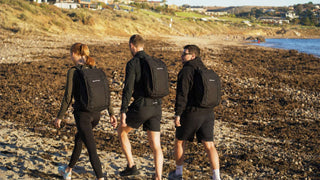
Rucking is walking with a weighted backpack. It combines cardiovascular training and strength work in a single low-impact activity that suits all fitness levels. A typical ruck involves carrying 10 to 20 percent of your bodyweight over a set distance or time.
The Simple Definition
Rucking is what happens when you put weight in a backpack and start walking. That's the entire premise. The load does the work that running speed does for runners: it pushes your heart rate up, recruits more muscle, and burns more calories per step.
Three variables define any ruck: weight, distance, and duration. You can adjust any of them independently as your fitness builds. The word itself comes from "rucksack," which traces back to the German der Rücken, meaning "the back."
What makes rucking different from most other forms of cardio is that it stacks two stimuli at once. You're getting Zone 2 aerobic training and a steady strength load through your legs, core, and back, all in the same session. Few other walking-based activities do that.
Where Did Rucking Come From?
Carrying weight over distance is one of the oldest training methods in human history. Greek Hoplites, Roman Legions and Byzantine infantry all marched with around 13 to 15 kilograms of gear. According to the Roman writer Vegetius, recruits were taught loaded marching before they were ever handed a weapon.
For the next two thousand years, soldiers carried roughly the same load. That changed in the Crimean War of the 1850s, when British troops started carrying around 30 kilograms. Loads kept creeping up through both World Wars, Korea, Vietnam, and by the wars in Iraq and Afghanistan, the average soldier was marching with close to 45 kilograms on their back.
Different militaries gave the practice different names: yomping in the Royal Marines, tabbing in the Paras, stomping or humping elsewhere, the Norwegian foot march.
The crossover into mainstream fitness really kicked off in the early 2000s. Today the people pushing rucking forward aren't drill sergeants. They're longevity doctors, neuroscientists and authors. Peter Attia talks about it on his podcast as a longevity tool. Andrew Huberman builds it into his weekly Sunday protocol for Zone 2 work in nature. Michael Easter has written entire books on it, with a central argument that humans aren't really "born to run" so much as we're born to carry. His evidence from modern hunter-gatherer studies suggests our ancestors carried tools, animal parts and supplies far more often than they sprinted, with everyday loads of 5 to 10 kilograms and post-hunt loads sometimes well over 35 kilograms.
In other words, rucking isn't a fitness trend. It's the most ancient movement pattern there is, dressed up in modern training language.
The Benefits of Rucking
This is where the case for rucking gets interesting. The science isn't fluffy.
Cardiovascular fitness
A 2019 study in the Journal of Strength and Conditioning Research found that healthy men who completed a 10-week rucking program saw significant increases in VO2 max, the gold standard measure of aerobic capacity. VO2 max is one of the strongest predictors of long-term health and longevity that exists.
The reason rucking works so well for the heart is that it parks you in Zone 2 effortlessly. Zone 2 is the aerobic intensity range (roughly 60 to 70 percent of max heart rate) that endurance athletes and longevity researchers identify as the metabolic sweet spot. It builds mitochondrial density, improves fat oxidation, and develops your aerobic base without smashing recovery.
A 10 kilogram pack at a comfortable walking pace pushes most people straight into Zone 2. No jogging required. The weight does the work.
Calorie burn
Rucking burns significantly more calories than regular walking. At moderate loads (10 kilograms and above), rucking roughly doubles the calorie burn of the same unloaded walk. Heavier loads and faster pace push that figure higher still.
The reason is more muscle recruitment. Carrying a loaded pack forces the stabilisers in your core, posterior chain, shoulders and hips to work continuously in a way they simply don't during normal walking. Your cardiovascular system responds accordingly.
Worth noting: research physiologist David Looney at the US Army Research Institute of Environmental Medicine has flagged that current calorie models likely underestimate rucking's true burn, particularly when any incline is involved.
Strength and muscle activation
You're under load for the entire session. That's a significant amount of time under tension for the traps, lats, core, glutes, quads, hamstrings, calves and the smaller stabilisers around your hips and ankles. Few activities cover cardio and resistance training in the same hour. Rucking is one of them.
This is also why rucking is one of the only activities that satisfies both halves of the Australian government's adult exercise guidelines (aerobic activity plus muscle-strengthening work) in a single session.
Bone density
This is one of the most underrated benefits. Bone density peaks in your early 30s, then declines by roughly 0.3 to 0.5 percent per year. By age 70, the loss is clinically significant. Osteoporosis affects 1 in 3 women and 1 in 5 men over the age of 50.
Cardio alone doesn't do much for bones. Cycling and swimming are great for the heart and lungs but they don't load the skeleton. Rucking does. Every step under load applies compressive force through the spine, hips, knees and ankles, which signals osteoblasts (the cells that build bone) to do their job.
A bone disease specialist at the Mayo Clinic has specifically recommended weighted walking for skeletal health. One often-cited study found that older women who trained with weighted loading didn't lose bone density, while a comparable group training without it did.
Mental health
The mental health story for rucking is compelling because the benefits stack across multiple mechanisms at once.
A 2019 international review of moderate-intensity aerobic exercise found it functioned as an effective antidepressant for people with depression, with sessions averaging 45 minutes three times per week. The American Psychiatric Association describes regular exercise as comparably effective to medication for many people with mild to moderate anxiety or mood disorders.
Rucking layers three evidence-backed interventions at once:
- Aerobic exercise triggers BDNF and endorphin release.
- Outdoor and nature exposure lowers cortisol and stress hormones, with measurable effects after just 20 to 30 minutes.
- Resistance loading has its own mood benefits. A landmark 1997 study found that depressed elderly people who lifted weights a few times a week saw nearly a 60 percent reduction in depression scores, with 14 of 16 no longer meeting clinical criteria for depression after 10 weeks.
The honest version: most of the mental health research applies to aerobic exercise broadly, not rucking specifically. But rucking is one of the only single activities that bundles aerobic work, nature exposure and resistance loading into the same hour. Mechanistically, it's about as stacked as you can get.
Time efficiency
You leave the house. You walk. You come home. That's the whole protocol. No gym membership. No equipment beyond a pack and some weight. No travel time, no parking, no waiting for a squat rack. For people with busy weeks and limited training time, rucking is one of the highest-yield activities you can do per minute on your feet.
Rucking vs. Walking vs. Running
Based on MET values from the Compendium of Physical Activities for a typical 75–80kg adult. Rucking figures assume a 10–15kg pack at a brisk pace on flat terrain.
| Walking | Rucking | Running | |
|---|---|---|---|
| Calorie burn (30 min) | 125–150 cal | 250–325 cal | 300–400 cal |
| Joint impact | Low | Low to moderate | High |
| Strength benefit | Minimal | Significant | Minimal |
| Injury rate | Very low | Low | High |
| Accessibility | High | High | Moderate |
The most important comparison is joint impact. For an 82-kilogram person, running sends around 400 kilograms of force through each knee per stride. Walking with a loaded pack sends roughly 150 kilograms through the same joint, only slightly more than the 120 kilograms generated by unloaded walking. Over thousands of steps, that difference in cumulative joint stress is enormous.
The injury data backs this up. A University of Pittsburgh study tracked 451 soldiers across a year of training and recorded 28 exercise-related injuries. Of those, 18 came from running, 7 from lifting weights, and only 3 from rucking. Easter's reporting on Special Forces training data puts the gap even more starkly: roughly six times more injuries from running than from rucking under controlled conditions.
Running burns more calories per minute at equivalent effort. That isn't in dispute. But most people can't sustain hard running consistently, and the recovery cost is high. Rucking is sustainable. You can do it most days of the week without knees and Achilles tendons falling apart, which means total weekly volume often comes out higher than running over a typical training month.
Is Rucking Right for You?
Almost certainly, yes.
Rucking suits beginners, lifelong runners coming off injuries, parents who can't carve out gym time, desk workers who need postural help, people in their 50s and 60s building bone density, and elite athletes looking for low-impact aerobic work. Few activities have this wide a fit.
One thing worth saying clearly: a well-fitted pack actually improves posture rather than wrecking it. The load sits high on your back and forces an upright torso and engaged core. If you slouch under it, the weight migrates to your knees and ankles and the discomfort makes you correct fast. After a few weeks of consistent rucking, the postural muscles adapt and the upright carriage starts to show up in everyday standing and sitting too. In an age of laptops and tech neck, that's not a small thing.
The cost of entry is low. You need a backpack that's actually built to carry real weight, and you need something to put in it.
If you're new to rucking and want a clear path, our rucking for beginners guide covers gear, how to load the pack properly, form, footwear, and how to build distance and weight progressively without getting hurt. If you're ready to get going now, the Ruckaway rucking backpack is built specifically for this kind of training.

Where to Ruck (A Quick Note for Australians)
Rucking works on suburban footpaths just as well as it does on trails. Michael Easter has been clear on this: pavement counts. The weight is doing the work, not the terrain.
That said, Australia has some of the best walking country on the planet, and a long ruck through the bush is hard to beat. We've put together a separate piece on Australian rucking routes covering tracks in every major capital and a few worth driving for.
Frequently Asked Questions
Is rucking safe for beginners?
Yes. Start light (around 5 to 10 percent of bodyweight), keep walks under 45 minutes for the first couple of weeks, and progress slowly. The injury rate for sensibly programmed rucking is significantly lower than running.
How far should a beginner ruck?
Start at 2 to 3 kilometres with a light load. Build to 5 kilometres before adding meaningful weight. Most beginners are comfortably rucking 5 to 8 kilometres with a moderate pack within a month.
Can I ruck every day?
For most healthy adults, yes, with caveats. Daily rucking at light loads (under 10 kilograms) is fine and is how many regular ruckers actually train. If you're carrying heavier loads, leave a day between sessions for recovery.
Does rucking build muscle?
It builds and maintains functional muscle in the legs, glutes, core and upper back. It won't replace dedicated strength training for hypertrophy, but it will meaningfully improve postural strength and lower body endurance, especially for people coming from a sedentary baseline.
Key Takeaways
- Rucking is walking with a weighted backpack, stacking Zone 2 aerobic training with a steady strength load in a single session — two evidence-backed exercise types in one activity.
- At moderate loads (10 kilograms and above) rucking roughly doubles the calorie burn of unloaded walking, with meaningfully lower joint impact and a dramatically lower injury rate than running.
- The mental health benefits are mechanistically stacked: aerobic exercise, outdoor exposure, and resistance loading all operating at once, making it one of the most efficient activities for both body and mind.