
Quick Answer
Weighted vest or weighted backpack: which should you start with?
Start with a weighted backpack if most of your training is going to be walking. It carries more, costs you more energy for the same load, holds its shape as you tire, and gives you somewhere to put water and layers. Start with a weighted vest if you already walk with weight and want your bodyweight work to get harder, since a vest stays put through press-ups, squats and step-ups.
They are built for different jobs, so plenty of people end up owning both eventually. Almost nobody needs both on day one. If you are completely new to the idea of training under load, start with what is rucking.
Where does the weight actually sit?
That is the whole difference, and everything else follows from it.
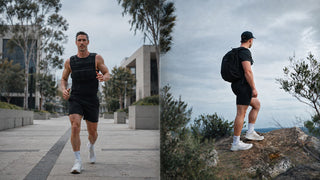
A vest holds the load across your chest and upper back, close to your centre of mass, split front and back. A rucking backpack holds it all behind you, ideally high and tight against your spine. In a purpose-built pack the plates sit in a dedicated compartment rather than sliding around in the main body of the bag, which is what stops the load dragging your shoulders backwards.
Same 10 kilos, two quite different experiences. The vest feels like you have gained weight. The pack feels like you are carrying something.
Which one burns more calories on a walk?
For the same weight, walking with a weighted backpack costs you more energy than walking with a vest.
That comes out of the US Army's load carriage research. In 2024, a team led by David Looney published a study in Medicine & Science in Sports & Exercise extending the Army's Load Carriage Decision Aid to cover vest-borne loads. Twenty adults walked at loads ranging from zero to 66% of bodyweight across eleven different speeds. Their finding: metabolic cost climbs as vest load goes up, but less steeply than it does for the same load carried in a backpack.
The reason is simple mechanics. Load carried away from your centre of mass takes more work to stabilise, so your whole system spends more on balance and posture with a pack than with a vest.
For scale, the 2024 Adult Compendium of Physical Activities puts level walking at a moderate pace at around 3.5 METs, with loaded walking well above that. At a 10 kilo load you are looking at roughly double the calorie burn of the same walk unloaded. We go through the numbers properly in our guide to rucking for weight loss.
What happens once you get tired?
This is the part most comparisons skip, and it is the strongest argument for a pack over distance.
Michael Easter covers it in Walk with Weight, drawing on physical therapist Kelly Starrett. With a pack, the load pulls straight back, so you lean into your straps and resist it through your abs and posterior chain. When those tire, your skeleton takes over. It is a stable arrangement that holds up over hours.
A vest wraps the load around you, so there is nothing to lean into. Your muscles do all the stabilising work. Starrett's observation from working with Marines in body armour is that once fatigue sets in, people round their shoulders and slump inside the vest, because there is no equilibrium to find. Over a long walk with a heavy load, that is how good form quietly disappears.
Load matters here. Easter's reading of the research is that packs and vests carry about equally well up to roughly 10 to 15% of your bodyweight. Go heavier than that, or walk further, and you want more of the load sitting on your back.
Does a weighted backpack do anything for your core?
More than you would expect, and this is one of the genuinely surprising findings in the research.
Biomechanists at the University of Waterloo measured back muscle activity in men walking with a loaded pack. Your erector spinae, the muscles running either side of your lower spine, actually worked less under load than they did walking with nothing. The extra work went to the abs instead. Leaning slightly forward to counter the pack reduces the torque on your lower back and shifts the demand to your core.
Back specialist Stuart McGill, cited in Easter's book, has gone as far as using loaded carries as part of rehab for people recovering from disc problems, with the weight kept low and close to the back. Gentle motion under moderate load tends to suit spines.
If you have been putting off rucking because you assumed weight on your back was asking for trouble, we go into that properly in is rucking bad for your back.
What is a weighted vest better at?
Bodyweight movements, and anything where a pack would get in the way.
Try a press-up wearing a loaded backpack and you will understand within about three seconds. The weight hangs off your shoulders, swings when you move, and pulls you off balance the moment you are not upright. A vest keeps everything strapped to your torso, so it stays put through squats, lunges, step-ups, pull-ups and carries. Hands free, load stable, full range of motion.
This matters more than it sounds for anyone over 45. Peter Attia's argument in Outlive is that you need both cardiovascular work and resistance work, and most people who avoid the gym get the first and skip the second. Rucking covers the cardio side well. A vest is one way to load bodyweight strength work without owning a squat rack.
There is decent evidence behind that. The Wake Forest team who ran the INVEST trial, one of the largest studies of weighted vest use in older adults, noted that vests have been shown to improve strength and sit-to-stand performance, which is one of the better predictors of staying independent as you age.
How heavy can you go with each?
Standard loading guidance for vests starts at around 5% of bodyweight and tops out near 10% for most people, with UCLA Health suggesting 5% as a starting point for walking. Easter notes that most vests on the market cap out around 9 kilos, though adjustable models give you more range.
A pack gives you more headroom. Ours is rated to 30 kilos and still sits properly when loaded, because the plates lock into a compartment high against your spine rather than shifting around in the bag. That ceiling matters more than people expect once you are a year in and the 10 kilos that felt hard in January feels like nothing.
Whichever you go with, the load is worth getting right from the start. Our guide to how much weight to ruck with walks through where to begin and how quickly to add.
So which should you buy first?
Work backwards from what you will actually do most weeks.
If the honest answer is walking, whether that is a lap of the local oval, walking the dog, one of the Australian rucking routes on the weekend or the commute, buy the pack. It carries more, it works you harder for the same weight, it holds its shape when you tire, and it gives you somewhere to put water, a jacket and snacks. That is the version of training most people stick with, because it slots into a walk you were already doing.
If you already walk with weight and what you are missing is resistance work, and you want press-ups and squats and step-ups to get harder without joining a gym, the vest is the better buy.
Starting from nothing and want one thing that covers the most ground? Get the pack. It is the easier habit to keep going, and it gives you something to build on.
One thing worth knowing before you buy either: ordinary backpacks are not built for this. Loaded properly they sag, the weight drops to the bottom and swings, and the straps dig in. We go through what fails first in can any backpack be used for rucking.
Frequently asked questions
Can you use a weighted vest for rucking?
Yes, and plenty of people do. It sits closer to your centre of mass so it feels settled over short distances. The trade-offs are that the same weight does slightly less work for you, and that once you fatigue there is nothing to lean into, so posture tends to collapse inward on longer walks. You also have nowhere to put water or a jacket.
Is a weighted vest or weighted backpack better for your back?
Both are fine when loaded sensibly. Research from the University of Waterloo found that a loaded pack reduces torque on the lower back and shifts the work to your abs, and back specialist Stuart McGill has used loaded carries in disc rehab. A vest gives you nothing to brace against once you tire, which is why loads above roughly 10 to 15% of bodyweight suit a pack better.
How much weight should I use in either one?
Start at 5 to 10 kilos and build from there. Most people land between 10 and 20% of bodyweight for regular training, and Michael Easter's reading of the research puts 10 to 15% of bodyweight as the point where a pack starts to carry better than a vest. Going too heavy too early is the most common mistake we see.
Should I get both a vest and a weighted backpack?
Not at the same time. They do different jobs, so a lot of people add the second one later once the first has earned its keep. Pick the one that matches how you will train this month, use it consistently, and expand when you find a real gap.
Start with the walk
Most people reading this will get further with a pack than a vest, because walking is the easier habit to keep going.
Our weighted backpack is built for exactly that. A dedicated weight compartment that holds ruck plates high against your spine, an internal frame that keeps its shape under load, and wide shoulder straps with high-density padding so 15 or 20 kilos sits comfortably instead of digging in. Load it up, get out the door, and let the walk do the work.
New to all of this? Our rucking for beginners guide covers form, footwear, and how to build weight and distance without hurting yourself.
Key Takeaways
- A weighted backpack costs you more energy than a vest at the same load, so it does more work per kilo on a walk.
- Packs and vests carry about equally well up to 10 to 15% of bodyweight. Above that, or over longer distances, the pack holds form better because you have something to lean into.
- A vest wins for bodyweight strength work: press-ups, squats, step-ups and pull-ups, where a pack swings and gets in the way.
- If most of your training will be walking, start with the pack. Add a vest later if bodyweight strength becomes the gap.