
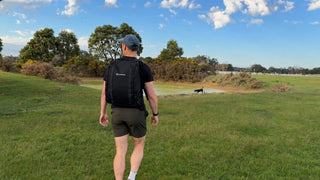
Walking is easy to stick with and easy to outgrow. Running gets you fit fast, but plenty of knees and shins don't last the distance.
Rucking sits between the two. Put weight on your back and an ordinary walk starts building strength and burning more, while every step stays low impact. Turn up the load, the pace or the hills and it can match a run for calories. If you're new to it, our guide to what is rucking covers the basics.
Here's how the three compare on calories, impact and what they do for your body, plus how runners and hikers use rucking to train. Every number assumes an 80kg adult, so scale up or down for your own weight.
Key Takeaways
- Rucking with 10kg on flat ground burns 10 to 20% more than walking. Add hills, more weight or a quicker pace and it climbs to 600 to 800 calories an hour (2024 Adult Compendium of Physical Activities).
- Kilometre for kilometre, a loaded ruck burns about as much as a run.
- Each step lands with around 40% less force than a running stride.
- Runners use rucking for low-impact training, and hikers use it to get ready for big trips.
The quick comparison
| Walking | Rucking | Running | |
|---|---|---|---|
| Calories per hour (80kg adult) | ~300 | 350 to 800, depending on load and hills | ~740 at 10 km/h |
| Calories per kilometre (flat) | ~60 | ~70 with 10kg, ~80 with 20kg | ~74 |
| Force per step | 1.0 to 1.5x bodyweight | 1.1 to 1.7x bodyweight | 2.0 to 2.9x bodyweight |
| Strength work | Light | Legs, glutes, core and upper back | Light to moderate, mostly legs |
How many more calories does rucking burn than walking?
In 2024, the Adult Compendium of Physical Activities rated a moderate flat walk at 3.8 METs, about 304 calories an hour for an 80kg adult (Compendium, Walking, 2024). Military load carriage research puts a 10kg pack on the same flat route at roughly 10 to 20% extra, taking you to around 350 (Drain et al., Journal of Science and Medicine in Sport, 2017).
That's your starting point. Every lever from there adds more.
Load. Go from 10kg to 20kg and a flat ruck climbs to around 410 calories an hour. Each extra kilo also takes a little more effort to carry than the one before it, so heavier loads push the calorie burn up quickly.
Hills. The biggest lever of the lot. The Compendium rates climbing hills with a 10kg-plus pack at 7.5 METs, about 600 calories an hour. That's double a flat walk. Make it steep and brisk and it rates 10 METs, about 800 an hour.
Pace. Speed counts too. A brisk unloaded walk at 5.6 to 6.3 km/h rates 4.8 METs against 3.8 for a moderate one, about a quarter more, and the same pattern holds with a pack on.
Stack them and the numbers move quickly. A hilly loop with 15kg at a decent clip burns far more than the same loop with nothing on your back. Our guide to rucking routes in Australia has hilly options in five capital cities.
How does rucking compare with running?
Distance for distance, they burn about the same. In 2024 the Compendium rated running at 10 km/h at 9.3 METs, about 744 calories an hour or 74 a kilometre for an 80kg adult (Herrmann et al., Journal of Sport and Health Science, 2024). A 10kg ruck on the flat burns about 70 a kilometre. At 20kg it's about 80, more than the run.
On flat ground, running gets through those kilometres twice as fast, so it burns more per hour. Take the ruck up a hill and that flips. A brisk, steep ruck at around 800 calories an hour out-burns a run at 10 km/h.
The fitness gains hold up too. In a 2019 Australian study, 10 weeks of weighted walking plus strength training significantly lifted men's estimated VO2 max, a key measure of aerobic fitness (Wills et al., Journal of Strength and Conditioning Research, 2019).
Which is easier on your joints?
Rucking, by a long way. In 1989, a Swedish force-plate study measured peak force at 1.0 to 1.5 times bodyweight when walking and 2.0 to 2.9 times when running (Nilsson and Thorstensson, Acta Physiologica Scandinavica, 1989). A 10kg pack adds about an eighth for an 80kg person, which still leaves each step landing with around 40% less force than a running stride.
That gap shows up in injury numbers. A 2007 systematic review in the British Journal of Sports Medicine found 19.4% to 79.3% of distance runners pick up a lower-limb injury in a year, most often at the knee (van Gent et al., BJSM, 2007).
Your back gets a better deal than you might expect, too. Most studies of walking on level ground with a backpack have found the lower back muscles work no harder than when walking without one, and often less (Sensors, 2023). More in is rucking bad for your back.
The one thing to respect is progression. Build the load up over a few weeks rather than starting heavy, and our rucking for beginners guide has a simple plan to follow. Our guide on how much weight to ruck with gives a starting load by bodyweight.
How runners and hikers use rucking to train
Rucking doesn't have to replace anything. Plenty of people use it to get better at the thing they already love.
Runners. A ruck adds aerobic training without the repeated impact of running, which makes it a good fit for easy days, recovery weeks or extra volume when your legs are already cooked from running. It also loads your glutes, core and upper back in a way running doesn't.
Hills are where it earns its spot. Cam Mitchell, who runs Cam's Run Club in Adelaide, uses hill sessions with a Ruckaway pack loaded to 10kg as part of his marathon prep. Climbing with load builds leg strength and works your heart hard while keeping the impact low.
Hikers. If you're training for a multi-day hike or a big day on the trails, carrying weight on shorter walks is the most direct way to prepare. In 2019, a study in the Journal of Strength and Conditioning Research put 15 men through 10 weeks of weighted walking and strength work. A 5km loaded march at the Australian Army minimum standard felt easier afterwards, and their physical performance improved across the board (Wills et al., JSCR, 2019).
The principle is simple: your body adapts to what you ask of it. Do your weekday walks with a loaded pack and the long days with a full hiking pack feel familiar instead of brutal.
Commuters. If you already walk to work or the train, swap your bag for a loaded pack. You get a workout five days a week without finding any extra time.
So which should you pick?
You're a runner. Keep running. Add a weekly ruck, ideally on hills, for strength and low-impact volume.
Running hurts. Rucking matches a run's calorie burn distance for distance, with around 40% less force through each step.
You already walk and want more from it. Add a pack, then find some hills. That combination can double what your walk burns.
You're over 50 and thinking long term. Muscle is what you'll want most in your 70s and 80s. Australia's physical activity guidelines recommend muscle-strengthening work on at least 2 days a week (Department of Health), so pair your rucks with some strength sessions.
FAQ
How many more calories does rucking burn than walking?
With 10kg on flat ground, about 10 to 20% more, or roughly 350 calories an hour against 304 for an 80kg adult. Add hills and it climbs fast: a 10kg-plus ruck on rolling hills burns about 600 an hour, double a flat walk, and a brisk, steep ruck about 800.
Does rucking burn more calories than running?
It can. Distance for distance they're close, at about 70 calories a kilometre for a 10kg ruck against 74 for running, and a 20kg ruck burns about 80. A brisk, steep ruck at around 800 calories an hour also out-burns a 10 km/h run. On flat ground, running burns more per hour because you cover twice the distance.
Is rucking good for runners?
Yes. It adds aerobic training and strength work for the glutes, core and upper back, with each step landing at around 40% less force than a running stride. That makes it a good fit for easy days and recovery weeks. Loaded hill sessions build leg strength without the impact of hill sprints.
Is rucking better than walking for weight loss?
Yes. A 10kg ruck burns 10 to 20% more than a flat walk, and adding hills can double the burn to about 600 calories an hour. Carrying load also gives your muscles a reason to stick around while you lose fat. Our rucking for weight loss guide covers the full program.
Ready to load up?
The rucking backpack has two weight pockets, each holding up to 15kg. Combine the ruck plates in 5, 10 and 15kg and you can build from 5kg up to 30kg in 5kg steps. Start light, find a hill and go.